Addiction & Overdose
How Historical Contexts Influence Overdose Rates
January 8, 2026
New research by Mudia Uzzi, PhD, Bloomberg Assistant Professor of American Health, and his colleagues, finds that where people live, and the discrimination faced by residents in these places, matters profoundly for who is most at risk of dying from an opioid-related overdose.
Using nearly 80 years of neighborhood-level data, the research team analyzed fatal overdoses across almost 800 census tracts before the COVID-19 pandemic (2017–2019) and during it (2020–2022). The research analyzed opioid overdose trends using death records from the Cook County Medical Examiner and compared incidents to the census tract where they occurred.
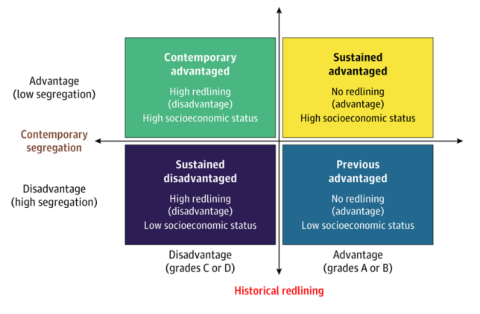
The researchers focused on historical redlining from the 1930s onwards, and contemporary racialized economic segregation. These measures classified neighborhoods into four trajectories of advantage or disadvantage over time (Figure 1). This methodology allowed them to measure how discriminatory policies enacted nearly a century ago continue to impact communities today.
Figure 1: Description of Neighborhood-Level Trajectories of Structural Racism
The findings are significant. Before the pandemic, neighborhoods that experienced both historical redlining and contemporary segregation had the highest overdose death rates, averaging more than two additional fatal overdoses per census tract compared with neighborhoods that were advantaged both historically and today. During the COVID-19 pandemic, overdose deaths increased across Chicago, but the burden shifted most dramatically to neighborhoods experiencing high levels of present-day segregation, even if they had not been redlined in the past. These areas had nearly four more overdose deaths per tract than advantaged areas.
This research contributes to a growing body of evidence that overdose deaths are a predictable outcome of policy choices, not an inevitable consequence of drug use and individual behavior. It provides evidence that discriminatory housing policies, disinvestment, and segregation are upstream determinants of overdose mortality.
Since the completion of the study, the Chicago Department of Public Health in Illinois has partnered with harm reduction organizations and advocacy groups to reduce overdose deaths in Chicago. From on the ground canvassing in communities hit hardest by the opioid epidemic, to increased access to naloxone, to drug testing services, their work has led to a 37% decrease in opioid overdose deaths since 2023.
Connect With Us
Receive all the latest news from the Initiative by signing up for the American Health Dispatch newsletter, subscribing to the American Health Podcast, and subscribing to our YouTube channel.
Contact Us